
theScore Bet Casino: License, Legitimacy, and Evidence Review

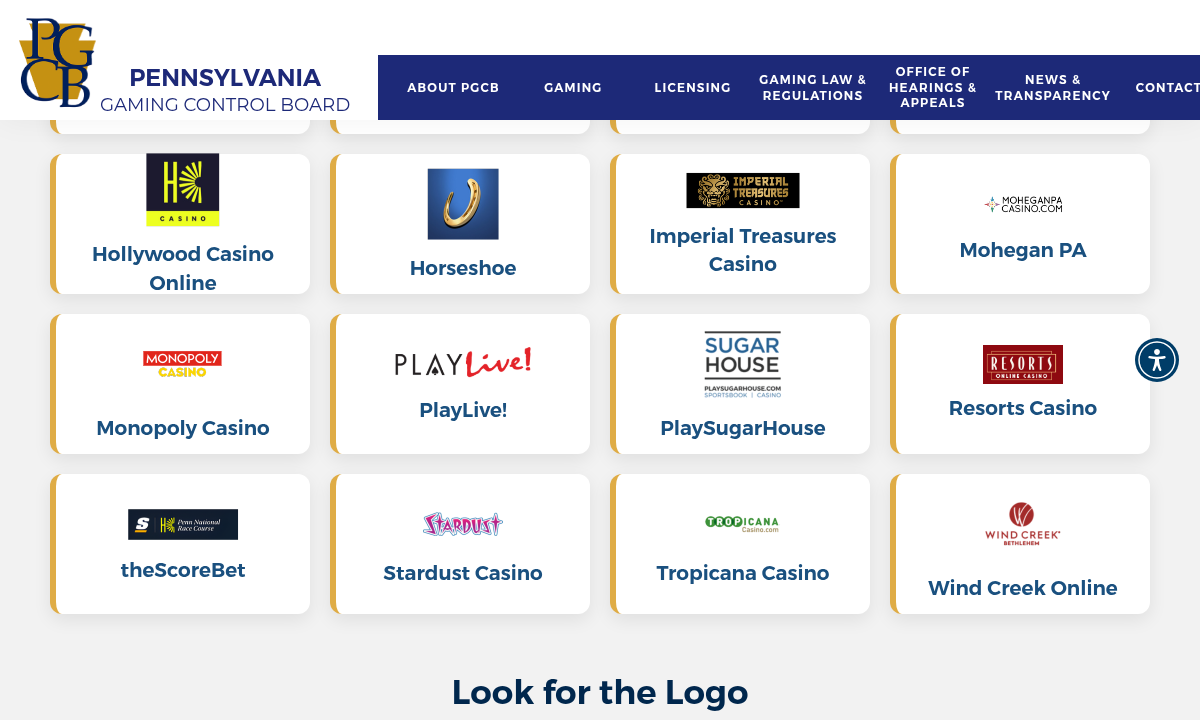
The decisive record is dated December 1, 2025. The supplied Pennsylvania authorization identifies the service under Hollywood Casino at Penn National Race Course and records that authorized slots and table games commenced on that date. The Pennsylvania Gaming Control Board directory still presented the named service among regulated Pennsylvania interactive gaming operators when checked on August 21, 2026.
That current primary record supports a green signal for the precise Pennsylvania relationship in the evidence packet: the name, the supplied address sportsbook.thescore.bet, the identified operator relationship, and Pennsylvania authorization. It does not establish nationwide legality, guaranteed withdrawals, specific banking methods, favorable customer service, or approval in another state.
| Question | Evidence-led answer |
|---|---|
| Is the named service legitimate in Pennsylvania? | Current primary evidence supports its regulated status under Hollywood Casino at Penn National Race Course. |
| Is it legal throughout the United States? | Not established. Internet gaming authorization is state-specific. |
| Has a withdrawal test been completed? | No withdrawal test was supplied. |
| Are payment methods or processing times verified? | No. Those details are absent from the accepted evidence. |
| Does a review-search result prove complaints? | No. It is contextual user-report material, not a regulatory finding. |
What changed on December 1, 2025
The license chronology matters because an old name match or undated search result would not be enough to answer whether the operation is currently legitimate. The supplied record states that PGCB-authorized slots and table games commenced on December 1, 2025 under the relationship described as theScore Bet under Hollywood Casino at Penn National Race Course.
A later check provides the current-status component. On August 21, 2026, the Pennsylvania Gaming Control Board directory presented 24 named brands as regulated Pennsylvania interactive gaming operators. The named service appeared within that official directory. Readers can inspect the Pennsylvania interactive gaming operator directory rather than relying on a logo, advertisement, app-store description, or review score.
The two dates perform different jobs. December 1, 2025 establishes the supplied commencement point for authorized slots and table games. August 21, 2026 is the date on which the official directory was checked. Neither date should be converted into an unstated license-expiration date; none was supplied.
Entity, address, and authorization map
A legitimacy check should connect three separate elements: the public-facing name, the actual internet address, and the regulated operator relationship. A matching name alone is weak because names and visual identities can be copied. The evidence packet provides the following map.
| Element | Verified value | Practical significance |
|---|---|---|
| Public-facing name | theScore Bet Casino | The name reviewed in the supplied records. |
| Exact internet address | sportsbook.thescore.bet | The address that must match before account access or payment activity. |
| Operator relationship | theScore Bet under Hollywood Casino at Penn National Race Course | The regulated relationship identified by the supplied Pennsylvania record. |
| Authorized activity | PGCB-authorized slots and table games | The activity stated in the packet. |
| Commencement date | December 1, 2025 | The dated start recorded for those authorized activities. |
| Current directory check | August 21, 2026 | The date the PGCB directory evidence was verified. |
| License expiration | Not supplied | No expiration date should be assumed. |
This map is narrower than a general endorsement. It supports the exact entity relationship and address supplied for Pennsylvania. It does not verify every similarly named application, advertisement, social account, email, or alternate address. A copied logo does not inherit the authorization of the regulated operation.
The logo shown here is an identification asset, not proof of authorization. The official directory capture and dated regulator record carry the evidentiary weight. That distinction is important when a clone reproduces familiar colors or imagery but sends a player to a different address.
Legitimate or a scam: the supported conclusion
For the precise Pennsylvania operation identified in the packet, current primary evidence supports a legitimate regulated status. The green signal rests on the regulator directory and the exact operator relationship, not on customer ratings or promotional claims. No official adverse record was supplied for this entity, and the packet contains no corroborated evidence establishing fraud.
Calling every negative user report false would also exceed the evidence. The packet includes a dated independent search surface for profiles mentioning the service. That material can indicate topics worth checking, but it cannot establish whether a particular allegation occurred, whether the right entity was involved, or whether a regulator reached a finding.
| Signal component | Finding | Boundary |
|---|---|---|
| Pennsylvania authorization | Supported by current primary evidence | Applies to the precise regulated relationship in Pennsylvania. |
| Scam finding | No such finding supplied | Absence from the packet is not proof that no dispute has ever occurred. |
| Customer satisfaction | Unknown | No representative satisfaction evidence was supplied. |
| Withdrawal reliability | Unknown | No documented withdrawal test or transaction record was supplied. |
| Other-state legality | Must be checked separately | Pennsylvania authorization does not create nationwide approval. |
The accurate answer is therefore conditional: legitimate and regulator-listed for the identified Pennsylvania operation, while payment performance, individual disputes, and legality outside Pennsylvania remain separate questions. A green regulatory signal should never be rewritten as a promise of winnings, uninterrupted access, or dispute-free service.
Where the legal conclusion applies
United States internet-gaming legality is jurisdiction-specific. The Pennsylvania record supports the activity and operator relationship described in that state; it does not authorize play everywhere in the country. Physical location, state rules, and the regulator’s current approved list all matter.
Michigan illustrates why a Pennsylvania listing cannot be reused as a national answer. The Michigan regulator distinguishes authorized providers from operators that have received cease-and-desist letters. Anyone assessing availability there should use Michigan’s legal-versus-illegal gaming guidance and current authorized-provider information rather than treating a Pennsylvania record as transferable.
New Jersey uses the same state-specific principle. Its regulator says that internet-gaming sites absent from the state’s approved list are not approved to offer internet gaming there. The relevant starting point is New Jersey’s approved internet gaming sites list.
| Location question | What the packet supports | What remains necessary |
|---|---|---|
| Pennsylvania | Current regulated-directory support for the identified relationship | Confirm the address and current directory entry before use. |
| Michigan | No entity-specific authorization supplied | Consult Michigan’s current authorized-provider information. |
| New Jersey | No entity-specific authorization supplied | Confirm presence on New Jersey’s current approved list. |
| Any other state | No conclusion supplied | Check that state’s competent regulator and location rules. |
A person traveling between states should not assume that an account’s existence makes casino play lawful or available at the new location. The green signal is not a fifty-state legal opinion.
Payments, withdrawals, and verification checks
No accepted record identifies deposit methods, withdrawal methods, minimum or maximum amounts, fees, processing windows, reversal rules, or payment-provider availability. None should be inferred from common industry practice or from another Penn Entertainment-related service. Banking options can vary by state, account, provider, and time.
There is also no completed deposit or withdrawal test. Consequently, the dossier cannot claim that payouts are instant, consistently fast, delayed, or refused. A regulator listing establishes authorization; it does not document the outcome of an individual transaction.
Before depositing, record the exact address, displayed payment terms, method selected, amount, timestamp, and transaction reference. Before requesting a withdrawal, preserve the balance, request confirmation, stated review window, identity-verification request, and every status change. Redact account numbers, identification documents, and financial details before sharing records outside a secure complaint channel.
| Payment issue | Verified here? | Sensible record to retain |
|---|---|---|
| Available deposit methods | No | The account cashier’s current method list and terms. |
| Available withdrawal methods | No | The options shown to the verified account. |
| Processing time | No | Submission time, stated window, and status history. |
| Fees or limits | No | The terms displayed before confirmation. |
| Successful payout test | No | No test result exists in the packet. |
| Failed payout finding | No | No competent-source finding was supplied. |
Do not send more money merely because an unsolicited contact says an additional deposit, tax, insurance charge, or unlocking payment is required. First confirm that the communication belongs to the exact regulated service and use the official account channel. The internal payment-check framework provides a structured way to separate published terms from observed transaction evidence.
Identity verification and account controls
The evidence packet does not supply the operator’s identity-verification policy, document list, review time, age-check procedure, geolocation process, account-lock rules, or source-of-funds requirements. It would be inaccurate to describe any of those details as verified.
Identity checks and payment disputes should be documented separately. A request for verification does not by itself prove wrongdoing, but an unexplained request should not be satisfied through an unverified email, text message, social profile, or alternate address. Access the account only after independently confirming sportsbook.thescore.bet, then compare the request with information presented inside the authenticated account or an established support channel.
Keep a dated log of what was requested, when it was submitted, the stated reason, and any promised review period. Retain confirmation numbers while minimizing unnecessary copies of sensitive documents. If a document request appears inconsistent, ask for the policy basis and escalation route in writing.
Account controls are also not evidence of state authorization. A functioning sign-in screen, successful geolocation attempt, or accepted deposit cannot replace the regulator directory. Conversely, a verification delay is not automatically a scam finding. The facts needed to assess a dispute include the precise address, account timeline, applicable terms, communications, and transaction records.
Complaints and the user-report chronology
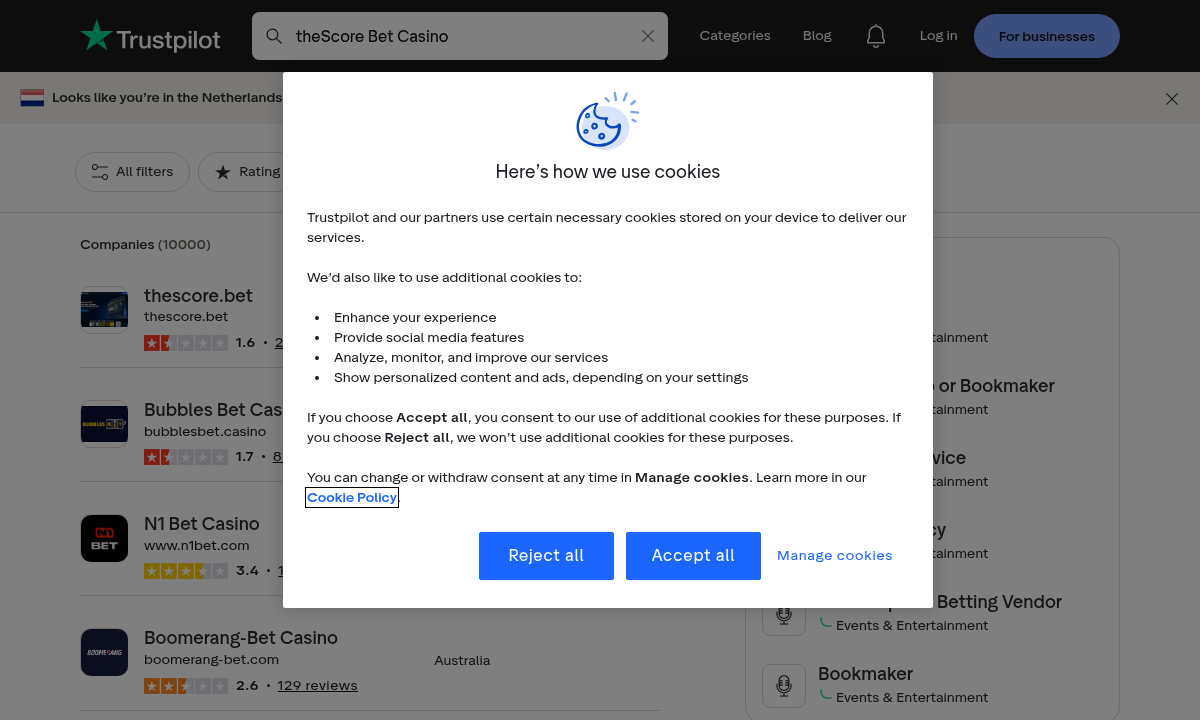
The user-context record was checked on August 21, 2026. It is an independent search surface for review profiles mentioning the casino. It does not prove any allegation, safety result, licensing conclusion, or complaint finding. No particular complaint, date of incident, amount, response, or resolution was supplied.
A useful complaint chronology begins with records, not conclusions. Note the account name or masked identifier, exact address used, state and physical location, incident date, amount, transaction reference, applicable term, support contact, response, and requested remedy. Preserve original timestamps and avoid editing screenshots in a way that removes context.
Start with the service’s authenticated support route if it is safely accessible. State one issue, provide a concise timeline, identify the desired correction, and request a case number. If the response does not resolve the issue, follow the competent state regulator’s complaint process. The internal complaint and scam-warning guide explains how to organize an allegation without presenting it as an established fact.
Urgent harm, loss of control, or pressure to continue depositing is different from an ordinary service dispute. Stop play and use responsible-gambling resources or urgent support options instead of trying to recover losses through further wagering.
Clone and impersonation checks
A clone may copy a name, logo, promotional phrase, or screen layout while using an unrelated address. The strongest practical check is therefore the complete address bar, not visual familiarity. For the operation assessed here, the supplied exact address is sportsbook.thescore.bet.
Check every character before signing in. Treat added words, substituted letters, unexpected hyphens, unfamiliar top-level domains, shortened links, and redirects to unrelated addresses as reasons to stop. A secure-connection symbol only indicates an encrypted connection to the address shown; it does not prove that the recipient is the regulated entity.
Compare the public-facing name and operator relationship with the current Pennsylvania directory. Do not rely on a search advertisement as the final destination. Password-reset requests, payment instructions, or identity-document demands arriving through unsolicited messages deserve independent confirmation through a known route.
The supplied logo may help recognize the intended service, but it cannot authenticate an address because an image is easy to copy. Likewise, the regulator capture is historical evidence from its check date, not a live interface. Recheck the official directory when making a new decision.
If the address differs, do not enter credentials, provide documents, deposit funds, or attempt a withdrawal through it. Preserve the suspicious address and message for a complaint or correction report without visiting additional links contained in the message.
Remaining risks and open questions
The primary evidence resolves the central Pennsylvania authorization question, but it leaves material operational questions open. No license-expiration date was supplied. No payment schedule, account terms, bonus rules, game catalog, customer-support hours, responsible-gambling controls, cybersecurity assessment, or transaction test was accepted for this review.
| Open question | Current status | What would resolve it |
|---|---|---|
| License expiration date | Unknown | A current competent regulator record stating the date. |
| Deposit and withdrawal options | Unknown | Current account terms or dated operator documentation. |
| Withdrawal performance | Untested | A documented, privacy-safe transaction test. |
| Identity-check timing | Unknown | Current policy plus a documented case timeline. |
| Complaint outcome | None supplied | A dated regulator decision or complete documented resolution. |
| Service quality | Not rated | Evidence suitable for that separate question. |
These unknowns do not reverse the green regulatory signal, because that signal concerns the precise current primary evidence. They do limit what the signal means. Authorization is not a warranty for every transaction, and a user report is not an adjudication.
The principal avoidable risks are using the wrong address, assuming Pennsylvania approval applies in another state, sending sensitive documents through an unverified channel, accepting unsupported payment promises, or treating anonymous reports as settled findings. Each risk calls for a different check rather than a single broad verdict.
Evidence method, chronology, and corrections
The assessment gives primary regulator records more weight than operator statements or user reports. The Pennsylvania directory supports the regulated-status conclusion. Michigan and New Jersey regulator materials support only the general state-specific approval framework in their respective jurisdictions; they do not establish an authorization or adverse finding for this entity there. The review-search capture is retained only as context.
| Date | Evidence event | Evidentiary role |
|---|---|---|
| December 1, 2025 | Authorized slots and table games commenced under the supplied Pennsylvania relationship. | Establishes the dated authorization chronology. |
| August 21, 2026 | Pennsylvania operator directory checked. | Supports the current-primary green signal. |
| August 21, 2026 | Michigan and New Jersey regulator guidance checked. | Confirms that approval questions are state-specific. |
| August 21, 2026 | User-review search surface captured. | Context only; proves no allegation or outcome. |
The conclusion should change if a newer competent regulator record removes or materially alters the exact entity relationship, identifies an official adverse action, or shows that the address no longer corresponds to the listed operation. Transaction claims require transaction evidence; complaint findings require a competent decision or sufficiently corroborated documentation.
Corrections should identify the disputed statement, provide the relevant date and exact entity or address, and attach a competent record where possible. Sensitive personal or financial information should be redacted. Submit documented corrections through contact and corrections. The broader scoring rules are available in the evidence methodology.
Frequently asked questions
Is theScore Bet Casino a scam or legitimate?
Current Pennsylvania Gaming Control Board evidence supports the precise operation as legitimate and regulated under Hollywood Casino at Penn National Race Course. No official scam finding was supplied. That conclusion does not authenticate look-alike addresses or guarantee transaction outcomes.
What exact address should I verify?
The evidence packet identifies `sportsbook.thescore.bet`. Check every character in the address bar before entering credentials, uploading documents, or making a payment. A copied logo or familiar design does not authenticate a different address.
Is the casino legal everywhere in the United States?
No nationwide conclusion is supported. The verified authorization concerns Pennsylvania. Michigan, New Jersey, and other states maintain their own approval frameworks, so current status must be checked with the competent regulator for the player’s physical location.
Are withdrawals proven to be fast or reliable?
No. The accepted evidence contains no withdrawal test, processing-time record, payment-method list, fee schedule, or documented payout outcome. Regulatory authorization and transaction performance are separate questions.
Does the review-search capture prove customer complaints?
No. It shows only that a dated independent search surface existed for profiles mentioning the service. It does not prove an allegation, identify a regulatory finding, establish the correct entity, or show how any dispute ended.
How should I report a payment or account dispute?
Preserve the exact address, dates, amounts, transaction references, applicable terms, communications, and requested remedy. Seek a case number through an authenticated support route, then use the competent state regulator’s complaint process if escalation is necessary.