
Stardust Casino legitimacy, license, and withdrawal checks

A hypothetical withdrawal file: what can actually be decided?
Consider a clearly hypothetical case. A Pennsylvania player deposits, completes play, requests a withdrawal, and then receives a request for identity documents. Several days later, the cashier still shows the request as pending. That sequence can feel alarming, but it does not by itself establish fraud, prove that funds were confiscated, or show that the named operator violated a regulatory requirement.
The useful first question is not whether a delay feels suspicious. It is whether the account was opened on the precise regulated hostname, whether the identity details match, whether any bonus or payment restriction applies, and whether the operator has issued a written reason. A defensible case file would preserve the withdrawal amount, request time, transaction identifier, cashier status, document-request message, responses, and any stated deadline. Passwords, full card numbers, Social Security numbers, and unredacted identity documents should not be placed in a public complaint.
No completed deposit or withdrawal test was supplied for this assessment. There is therefore no supported claim about processing speed, approval rates, fees, limits, or the outcome of a real player’s request. The current green signal rests on a regulator record matching the Pennsylvania service, not on an anonymous review or a successful cash-out test.
| Hypothetical file item | What it can establish | What it cannot establish alone |
|---|---|---|
| Cashier timestamp and status | When a request appeared and how it was labeled | Why processing has not finished |
| Identity-document request | That verification was requested | That the request was improper |
| Written operator response | The operator’s stated position | An independent regulatory finding |
| Bank or wallet record | Whether money reached the destination | The legality of the service |
Evidence checklist and current verdict
The strongest supplied evidence is the Pennsylvania Gaming Control Board directory checked on August 21, 2026. It presents 24 named brands as regulated Pennsylvania interactive gaming operators. The accepted packet matches the exact hostname pa.stardustcasino.com to Pala Interactive, LLC under Valley Forge Casino Resort and records authorization for slots and table games, commencing May 2, 2023.
That direct hostname, operator, and authorization match supports a green signal for the Pennsylvania service. It answers “scam or legit” narrowly: the identified Pennsylvania operation has current primary regulatory support in the supplied record. It does not guarantee that every transaction will be instant, every dispute will favor a player, or every similarly named website is genuine.
| Check | Supplied result | Evidentiary weight |
|---|---|---|
| Exact hostname | pa.stardustcasino.com | Essential identity check |
| Operating entity and casino relationship | Pala Interactive, LLC under Valley Forge Casino Resort | Primary-record match |
| Pennsylvania authorization | Slots and table games | Primary regulatory support |
| Commencement date | May 2, 2023 | Recorded authorization chronology |
| License expiration | Not supplied | Unresolved; do not infer |
| Withdrawal test | None supplied | No performance conclusion |
The regulator’s current operator directory can be checked in the Pennsylvania Gaming Control Board record. The preserved capture below records the accepted primary evidence used for the verdict.
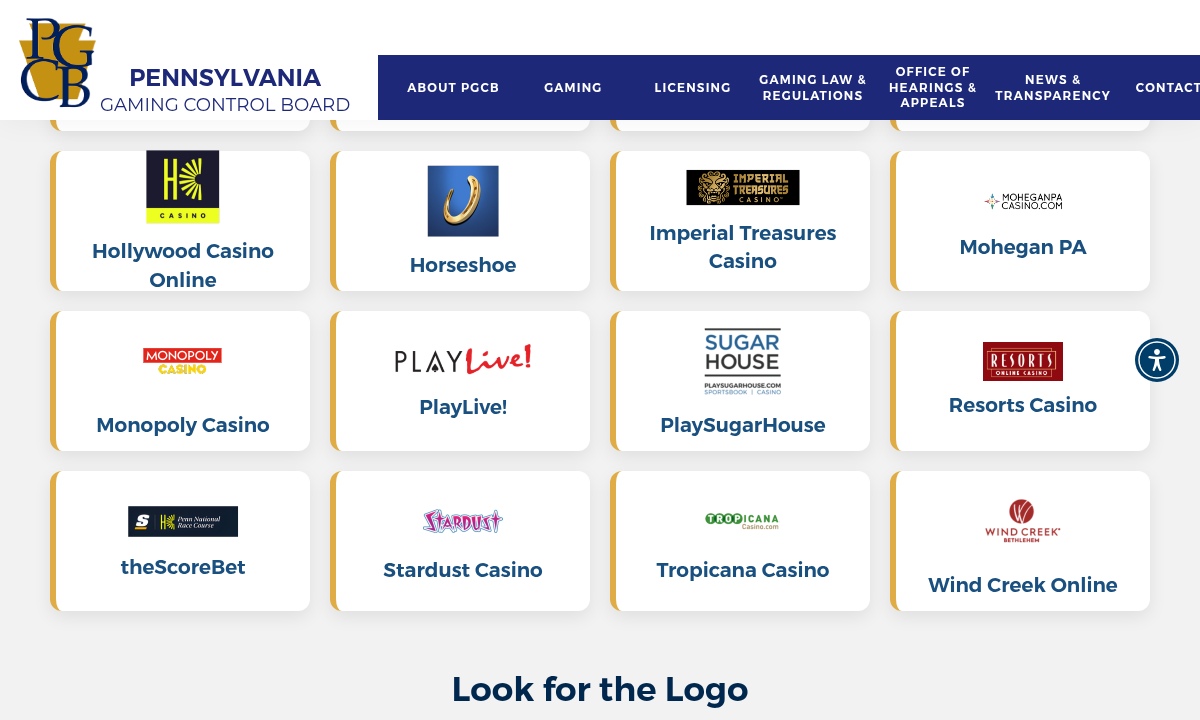
Exact hostname, operator, and license match
Legitimacy depends on matching all parts of the identity chain rather than recognizing a familiar name. For this service, the chain consists of the hostname pa.stardustcasino.com, the operating entity Pala Interactive, LLC, the relationship to Valley Forge Casino Resort, and Pennsylvania authorization for slots and table games. The supplied record says the authorization commenced on May 2, 2023.
A brand name alone is insufficient because a copied advertisement, misspelled address, unrelated application, or imitation support account can use familiar wording. Before signing in or submitting documents, type or compare the full hostname character by character. Check the text immediately before the first slash, watch for added words or hyphens, and reject an address that merely includes “stardustcasino” elsewhere in a longer hostname.
The packet provides no license-expiration date. That blank must remain an unknown rather than being converted into “permanent,” “indefinite,” or “valid everywhere.” The primary record supports Pennsylvania authorization as checked on August 21, 2026. It does not establish approval in every other state.
Legal availability is jurisdiction-specific. Michigan explains the distinction between authorized providers and operators receiving enforcement letters in its legal-versus-illegal gaming guidance. New Jersey separately states that a service absent from its approved list is not approved to offer internet gaming there; its approved internet gaming list is the relevant state-specific reference. A Pennsylvania match must not be treated as permission to play from Michigan, New Jersey, or any other location.
Payments, withdrawals, and the missing performance evidence
The evidence packet identifies no deposit method, withdrawal method, minimum, maximum, fee, processing window, reversal rule, or cash-out test. Claims such as “same-day withdrawals,” “instant banking,” or “no fees” would therefore be unsupported. Payment availability can also depend on location, account status, financial institution, and current cashier terms.
For a real withdrawal, preserve a private timeline before escalating. Record the amount requested, request date and time, destination selected, transaction identifier, displayed status, and every dated message. If the operator requests action, note exactly what was requested and when it was completed. Screenshots should show the relevant status while concealing balances or identifiers that are not necessary to the dispute.
| Withdrawal checkpoint | Evidence to retain | Practical question |
|---|---|---|
| Submission | Confirmation and transaction identifier | Was the request accepted by the cashier? |
| Verification | Dated request and submission receipt | Is a specific document still outstanding? |
| Review | Status changes and written messages | Has the operator explained the hold? |
| Completion | Bank, card, or wallet posting record | Did the destination receive the funds? |
| Rejection or reversal | Exact reason and applicable term | Is the reason documented and contestable? |
Do not cancel and resubmit repeatedly unless support instructs you to do so in writing; doing that can complicate the chronology. Do not pay an unknown third party to “unlock” a withdrawal, and never send documents through an address obtained from social media or an unsolicited message. Start from the verified hostname and use the contact path available inside the authenticated account.
Readers comparing cashier-risk controls can use the internal payment checks. That guidance is a checklist, not evidence that any particular method is currently offered here.
Identity checks and account consistency
Identity verification may involve confirming account ownership, age, location, address, or payment ownership, but the supplied records do not specify the documents requested by this operator or the time needed to review them. No particular document list should be assumed. The safe approach is to follow only a request shown after entering through the verified hostname or a contact channel independently reached from that service.
Account consistency matters. The legal name, date of birth, residential details, and payment ownership used during registration should be accurate. A nickname, outdated address, shared payment instrument, or mismatched account may create questions, but no conclusion about a particular case can be drawn without the operator’s stated reason and relevant terms.
Before uploading sensitive material, confirm the hostname again, inspect whether the request explains its purpose, and provide only what is required through the designated secure channel. Do not post identity records in a public review, send them to a reviewer, or disclose them to someone claiming they can accelerate approval. Redact account numbers when preserving copies for a complaint unless the competent recipient specifically requires the full value through a secure process.
A verification request is not proof of a scam. Conversely, a polished upload screen is not proof that a website is genuine. Regulatory identity, hostname accuracy, secure access, and the substance of the request must be considered together.
Complaint and escalation route
A productive complaint begins with a concise chronology and a requested remedy. Contact the operator through the verified account route, identify the transaction without exposing unnecessary personal information, state what happened in date order, and ask for a written explanation. Keep the case or ticket number and allow the stated response process to run unless urgent account-security concerns require immediate action.
If the response does not resolve the issue, organize the record before approaching the competent Pennsylvania channel. Include the account name, relevant dates, transaction identifier, amount, operator ticket number, concise issue statement, requested resolution, and redacted supporting records. Do not characterize a disputed delay as theft unless a competent finding establishes that conclusion.
| Escalation stage | Action | Record to preserve |
|---|---|---|
| Account support | Ask for the status and exact reason | Transcript, email, or ticket number |
| Written follow-up | State the chronology and requested remedy | Dated message and response |
| Regulatory escalation | Use the competent state process when appropriate | Complete redacted case file |
| Public correction request | Identify a factual error in this dossier | Primary record and checking date |
The internal complaints and scam warnings guide explains how to distinguish an allegation from an established finding. For an account-security emergency or immediate gambling harm, use urgent help rather than waiting for an ordinary editorial or support response.
Clone checks before login or document upload
The supplied evidence supports one exact Pennsylvania hostname. It does not validate look-alike domains, advertisements, social-media profiles, messaging accounts, or downloadable files reached elsewhere. A clone can copy colors and wording without copying regulatory status.
Begin with the hostname. Confirm pa.stardustcasino.com exactly, including the pa subdomain and the ending. A longer address that contains the name but ends under another domain is not the same destination. Avoid links sent by an unknown “agent,” and do not rely on a search advertisement as proof of identity. If a message creates urgency around a frozen balance, prize, tax, verification fee, or secret payment, pause and independently re-enter the verified address.
Next, compare the claimed operator relationship with the primary record: Pala Interactive, LLC under Valley Forge Casino Resort. A conflicting entity name deserves investigation rather than rationalization. Finally, check whether the service is being offered where the player is physically located. Pennsylvania authorization does not replace another state’s approval list.
Warning signs should be documented, not exaggerated. Preserve the full address, date, message headers where available, and redacted screenshots. Never sign in to a suspected clone merely to test it. A familiar logo, professional design, or working chat box cannot substitute for the exact regulatory match.
Risks, boundaries, and unresolved facts
The green signal is specific and limited. It reflects current primary support for the precise Pennsylvania hostname, entity relationship, and recorded authorization. It is not a prediction of game outcomes, a promise of payment speed, an endorsement of every term, or proof that no player will experience a dispute.
Important unknowns remain. The packet gives no license-expiration date, payment inventory, withdrawal timetable, fee schedule, identity-document list, complaint outcome, account test, or independently verified player transaction. It also supplies no official adverse record concerning the identified Pennsylvania operation. Silence on an issue is not positive proof; it is simply an evidence gap.
A user-review search was captured on August 21, 2026, but user reports are contextual allegations or experiences rather than regulatory findings. They may help identify questions to investigate, such as recurring verification or withdrawal themes, but they cannot establish the legal status of the operator. Individual reports may be incomplete, mistaken, duplicated, resolved later, or related to a different hostname.
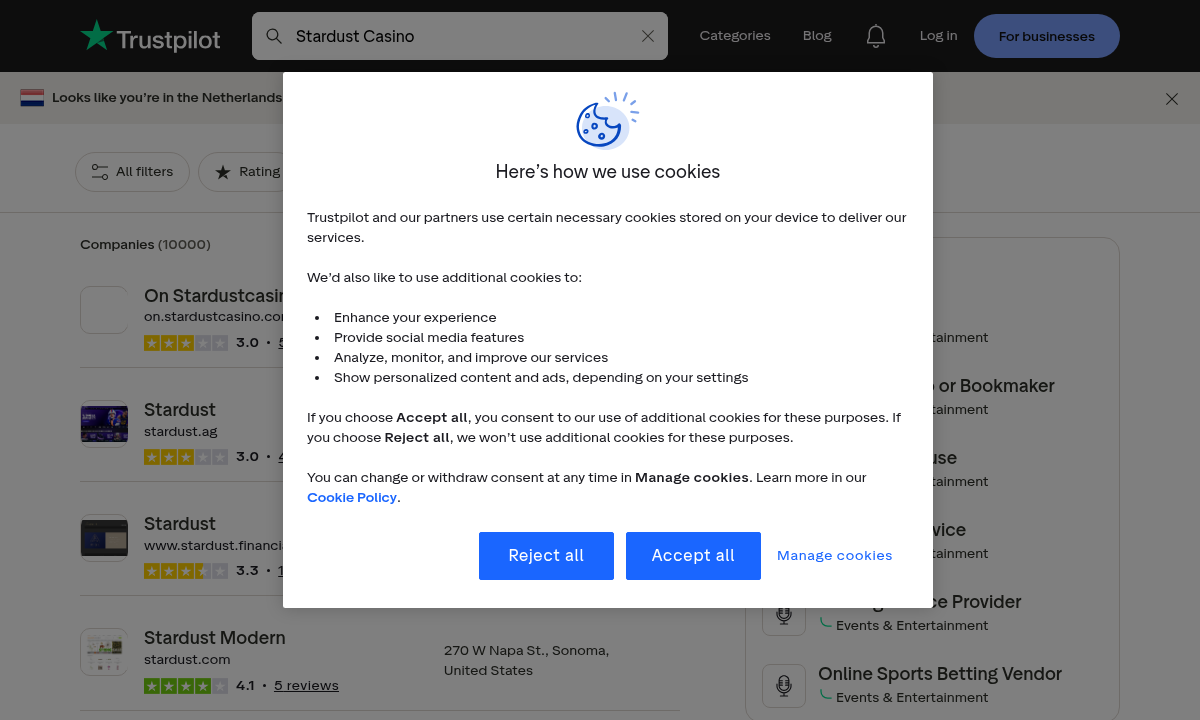
The appropriate conclusion is therefore precise: Stardust Casino is supported as a regulated Pennsylvania service at the stated hostname under the supplied current primary record. Transaction quality and any individual complaint must be assessed from separate dated evidence.
Evidence chronology and assessment method
The chronology begins with the recorded authorization commencement on May 2, 2023. On August 21, 2026, the Pennsylvania directory was checked and accepted as primary evidence for the current operator match. On the same date, Michigan and New Jersey materials were checked to establish the narrower principle that authorization is state-specific. The user-review search capture was retained only as context.
| Date | Record | Role in the assessment |
|---|---|---|
| May 2, 2023 | Authorization commencement supplied for the Pennsylvania operation | Establishes the recorded start date |
| August 21, 2026 | Pennsylvania operator directory checked | Supports hostname, entity, and authorization verdict |
| August 21, 2026 | Michigan guidance checked | Demonstrates state-specific authorization distinctions |
| August 21, 2026 | New Jersey approved-sites guidance checked | Demonstrates that another state uses its own approved list |
| August 21, 2026 | User-review search captured | Context only; no factual allegation adopted |
The method gives primary regulator records greater weight than operator statements or user reports. It requires an exact identity match and keeps jurisdictional conclusions within the state supported by the record. Missing details remain unknown. No withdrawal claim is accepted without transaction evidence, and no complaint becomes a finding merely because it appears in a review.
The broader assessment methodology describes this evidence hierarchy. Readers who have independently confirmed that they are eligible and wish to proceed can See the regulated play route. Responsible gambling information remains available through responsible gambling support.
Corrections and evidence updates
A correction request should identify the exact statement at issue and provide a dated primary record capable of changing it. Useful submissions include an updated regulator entry, a competent adverse order, a confirmed entity change, a hostname change, or an official authorization-status update. An advertisement, undated screenshot, copied directory, or unsupported accusation is not equivalent to a primary record.
Send factual correction material through the internal contact and corrections route. Do not include passwords, full payment numbers, unredacted identity documents, or information belonging to another person. A transaction complaint should use the operator and competent regulatory process; the correction channel is for factual accuracy in the dossier, not account resolution.
A future change in authorization, operator identity, hostname, or official status could alter the signal. Until supported evidence changes, the verdict remains tied to the precise Pennsylvania record checked on August 21, 2026.
Frequently asked questions
Is Stardust Casino a scam or legitimate in Pennsylvania?
The supplied Pennsylvania Gaming Control Board record supports the exact hostname `pa.stardustcasino.com` as a regulated Pennsylvania service associated with Pala Interactive, LLC under Valley Forge Casino Resort. That supports a legitimate-status conclusion for the matched Pennsylvania operation, not for look-alike domains or use in other states.
Is the service legal throughout the United States?
No nationwide conclusion is supported. The evidence establishes Pennsylvania authorization for the matched service. Michigan and New Jersey maintain their own state-specific authorization frameworks, so a Pennsylvania record should not be treated as approval in another jurisdiction.
Does the green signal guarantee a fast withdrawal?
No. The signal reflects a current primary regulatory match. No withdrawal test, processing time, fee schedule, or individual transaction outcome was supplied, so withdrawal speed and performance remain unverified.
What should I keep if a withdrawal is delayed?
Keep the request timestamp, amount, transaction identifier, cashier status, verification messages, support ticket number, written responses, and final payment record. Store them privately and redact passwords, full payment numbers, Social Security numbers, and unnecessary identity details.
Does an identity-document request prove fraud?
No. A verification request alone neither proves fraud nor proves that the request is proper. Confirm the exact hostname, use the secure channel reached from the authenticated account, understand what is requested, and preserve the dated correspondence.
How can I report a factual error in the evidence?
Use the contact and corrections route and identify the exact statement, the proposed correction, the primary record, and the date checked. Do not send account passwords, full financial credentials, or unredacted identity documents.