Cherry Jackpot Michigan Warning and Evidence Review
This is a Michigan-specific evidence signal, not a claim that every allegation is proven or that the service remains available there.
Michigan verdict: an official warning creates a red signal
Cherry Jackpot carries a red signal for Michigan. The Michigan Gaming Control Board named Cherry Jackpot Casino in a dated 2025 cease-and-desist news release. That official adverse record is directly relevant to someone asking whether the brand is authorized for Michigan online casino play. A licensing claim in the operator’s terms does not substitute for Michigan authorization.
The conclusion must remain narrow. The MGCB release is a Michigan regulatory record; it does not by itself prove that a particular customer lost money, that a withdrawal failed, that the website remains accessible from Michigan, or that the brand is unlawful in every US jurisdiction. No account registration, deposit, withdrawal, customer-support or geolocation test was performed.
| Question | Evidence-led answer | Confidence |
|---|---|---|
| Is there an official Michigan warning? | Yes. The MGCB named Cherry Jackpot Casino in a 2025 cease-and-desist release. | Primary regulatory record |
| Does the operator claim a licence? | Yes. Captured terms self-claim Anjouan licensing. | Operator statement only |
| Does that claim establish Michigan permission? | No. Michigan authorization must be checked through the state regulator’s records. | Primary regulatory framework |
| Was a withdrawal tested? | No. | Known limitation |
| Is a consumer loss proven? | No individual loss is established by the supplied records. | Not established |
Review the Michigan licence-check process
What the MGCB record establishes—and what it does not
The strongest evidence is the Michigan Gaming Control Board’s dated release. The agency named Cherry Jackpot Casino among the subjects of cease-and-desist action in 2025. Because the record comes from the competent state gaming regulator, it supports an official-adverse basis for the red signal in Michigan.
A cease-and-desist announcement is more significant than an anonymous complaint or an operator’s marketing claim. It records an action taken by the state regulator. It should therefore be considered before a Michigan resident sends funds, opens an account or supplies identity documents.
Its scope still matters. The record does not provide evidence of every event a user may want to know about. It does not document a completed deposit or cash-out test conducted for this review. It does not establish the outcome of any named customer dispute. It does not demonstrate whether access is currently available from a specific Michigan location, and it does not convert a Michigan determination into a nationwide legal conclusion.
| Supported by the record | Not established by the record |
|---|---|
| Cherry Jackpot Casino was named by the MGCB in a 2025 cease-and-desist release. | That every customer experienced a payment problem. |
| Michigan residents have a concrete regulatory reason for caution. | That a particular account or transaction resulted in a loss. |
| A Michigan authorization check is necessary. | That the site is currently reachable or accepting Michigan registrations. |
| A foreign licensing claim is not enough to show state approval. | That the brand is prohibited in every state or country. |
The appropriate wording is therefore “official Michigan warning,” not a claim that every interaction is fraudulent. The red signal reflects the state record, while unresolved payment or customer-specific questions remain unresolved.
Exact domain and identity checks
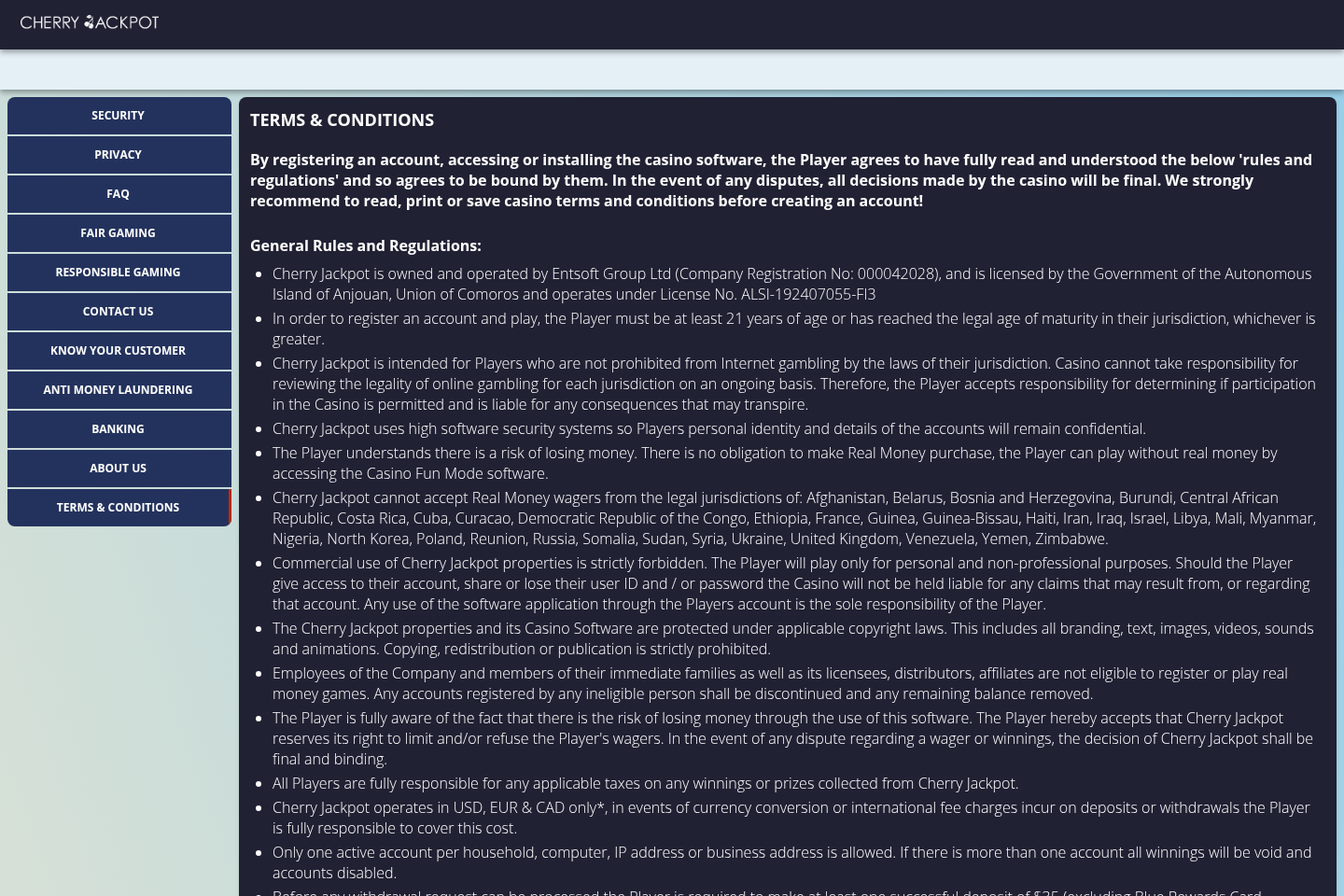
The published operator material supplied for review is the terms page on the exact host www.cherryjackpot.com. That domain match is useful when comparing operator statements with regulatory records, but seeing terms on a branded host is not proof that Michigan authorized the product.
A careful licence check should distinguish among four identifiers: the public-facing brand, the exact website host, the legal entity, and the product listed by the regulator. Similar names, redirects or references to an overseas licence should not be treated as equivalent to an entry on Michigan’s authorized-provider list.
- Record the exact host shown in the browser rather than relying on a search-result title or advertisement.
- Identify the legal entity named in the terms, privacy notice or account contract, if one is clearly disclosed.
- Compare the product and entity with the MGCB’s authorized online gaming provider list.
- Check whether the regulator’s listing identifies the same product and relationship, not merely a similar word or logo.
- Preserve dated copies of relevant terms if a payment, verification or account dispute already exists.
The available evidence does not establish a verified Michigan-authorized legal entity for Cherry Jackpot. It also does not support inventing an operator identity that is absent from the accepted records. Where the entity relationship remains uncertain, that uncertainty belongs in the risk assessment rather than being filled with assumptions.
Anjouan licensing claim versus Michigan authorization
The captured Cherry Jackpot terms self-claim Anjouan licensing. That is an operator statement, not an independent finding by the MGCB. Even if a foreign licence exists exactly as represented, it would not independently grant permission to offer regulated online casino gaming in Michigan.
Michigan authorization is a separate question governed by Michigan records. The MGCB publishes a list of authorized online gaming and sports betting platform providers. A user should match the specific product, entity and URL rather than infer approval from an overseas licence, a generic “licensed” label, the availability of a registration form or the acceptance of a payment method.
| Evidence item | Source role | What it can show | What it cannot show |
|---|---|---|---|
| 2025 MGCB cease-and-desist release | Michigan primary source | An official Michigan adverse action naming Cherry Jackpot Casino | An individual payment loss or nationwide legal status |
| MGCB authorized-provider list | Michigan primary source | Which products and provider relationships the state identifies as authorized | Facts about an unmatched or merely similar domain |
| Cherry Jackpot terms | Operator statement | The rules and licensing representation published by the operator at capture | Independent confirmation of the claim or Michigan permission |
| FTC report submission | Federal reporting route | A way to report suspected fraud | A finding, adjudication or guaranteed recovery |
This distinction is central to the “scam or legit” question. The verified fact is that Michigan’s gaming regulator issued an adverse notice naming the brand. The operator’s foreign-licensing representation does not answer the Michigan authorization question.
Account restrictions that may affect verification
The captured terms state that active accounts are restricted to one per household, computer, IP address or business address. Because this language comes from operator terms, it should be described as a self-published contractual rule rather than a regulator-confirmed outcome.
The supplied record does not show how the operator applies that rule, whether exceptions are available, or what documentation it requests when accounts appear related. Before any account activity, a user would need to understand how the restriction interacts with other people at the same address or on the same network. If an account already exists, preserving the version of the terms accepted at registration may help establish what language was in force.
Nothing in the evidence proves that a specific account was duplicated, suspended or closed under this provision. It would be inaccurate to convert the contractual restriction into a claim about an actual enforcement event. The practical concern is that the rule exists and may become material during verification or withdrawal review.
Payment and withdrawal evidence: major gaps remain
No deposit or withdrawal was attempted, so there is no first-hand payment evidence. The accepted records do not establish processing times, minimum or maximum withdrawal amounts, fees, supported payment methods, identity-check duration, approval rates or the reliability of any cashier option. They also do not prove a payout failure.
| Payment question | Status in the evidence | Useful record if a dispute exists |
|---|---|---|
| Was a deposit completed? | Not tested | Bank, card, wallet or blockchain transaction record |
| Was a withdrawal requested? | Not tested | Dated request confirmation and account ledger |
| Was identity verification demanded? | No case evidence supplied | Exact request, upload receipt and response history |
| Was a withdrawal denied? | Not established | Written decision, cited term and transaction chronology |
| Were funds recovered? | Not established | Provider credit, reversal notice or settlement record |
Anyone documenting a payment issue should preserve the amount, date, transaction identifier, payment descriptor, account status and exact messages. Keep copies of the terms and verification requests. Do not publish full card numbers, passwords, recovery phrases, government identification numbers or unredacted identity documents when seeking help.
For method-specific recordkeeping, consult the internal payment checks. A card dispute, bank transfer, payment app transfer and cryptocurrency transaction leave different evidence trails and may involve different provider rules or deadlines.
How to document an existing Cherry Jackpot dispute
A structured chronology is more useful than a general accusation. Start with the earliest relevant event and keep the original timestamp, amount and status for every entry. Separate what the account displayed from what a bank or payment provider independently recorded.
- Account records: registration email, username or account number, stated country and any address or device questions.
- Money records: deposits, withdrawals, reversals, fees and transaction references, with sensitive credentials redacted.
- Terms: the dated version presented when the account was opened and any later version cited by support.
- Verification: the exact documents requested, submission dates and confirmation that files were received.
- Communications: complete email threads or chat transcripts showing timestamps and case numbers.
- Outcome sought: release of a stated balance, explanation of a decision, correction of a record or closure of the account.
Do not alter screenshots or omit messages that change the context. Redact security credentials and unrelated personal data, but retain originals privately. A complaint should state allegations as allegations. A user report can document what one person says happened, but it is not automatically proof of a general practice. The available evidence contains no verified consumer case and supports no claim that a particular person was denied payment.
Regulatory and complaint routes
For the Michigan authorization question, the MGCB’s official records are the central reference. The regulator’s authorized-provider list should be used to match the exact product and provider relationship. The dated cease-and-desist release supplies the adverse record relevant to Cherry Jackpot.
If suspected fraud extends beyond a gaming-authorization question, the Federal Trade Commission provides a reporting route. Filing an FTC report does not mean the agency has found wrongdoing, and it does not guarantee that money will be returned. Preserve the confirmation generated by any report and avoid paying a third party that promises certain recovery.
Payment providers may also have their own dispute procedures and deadlines. A consumer should describe the transaction accurately rather than mischaracterize an authorized payment as unauthorized. The available remedy can depend on the payment method, facts and provider agreement; no recovery result can be promised from the available evidence.
See the unlicensed-casino reporting checklist
People approached by a supposed investigator, lawyer or recovery service should independently verify the organization. Upfront-fee recovery demands can introduce a second loss. The internal guide to casino refund and recovery scams explains warning signs without implying that every service is fraudulent.
What can responsibly be concluded
The evidence supports a clear but limited conclusion: Cherry Jackpot has an official adverse regulatory signal in Michigan because the MGCB named Cherry Jackpot Casino in a 2025 cease-and-desist release. A Michigan user should not interpret the operator’s Anjouan licensing claim as state authorization.
The records also establish that the captured operator terms impose a one-active-account restriction spanning households, computers, IP addresses and business addresses. That rule may be relevant to account or verification questions, but there is no supplied case showing how it was applied to a particular user.
There is no verified deposit or cash-out test, no documented customer loss, no proven payout failure, no support-response test and no geolocation test. The evidence does not establish current Michigan access or nationwide illegality. It also does not independently verify the operator’s foreign-licensing representation.
For Michigan purposes, the prudent evidence-based approach is to rely on the state regulator’s product-and-entity records, preserve documentation and avoid treating overseas licensing language as local approval. The red signal comes from official state action, not from an invented rating, anonymous review or untested payment experience.
michigan.gov · reportfraud.ftc.gov · content.govdelivery.com
Frequently asked questions
Is Cherry Jackpot legal in Michigan?
The available evidence does not establish Michigan authorization. The Michigan Gaming Control Board named Cherry Jackpot Casino in a 2025 cease-and-desist release. Michigan users should match the exact product, entity and URL against the MGCB authorized-provider list rather than rely on a foreign licensing claim.
Is Cherry Jackpot a scam?
The evidence supports an official Michigan red signal, not a blanket factual claim that every interaction is a scam. The MGCB record does not prove a particular consumer loss, failed withdrawal, current access or nationwide illegality.
Does an Anjouan licence allow Cherry Jackpot to operate in Michigan?
No such conclusion follows from the operator’s claim. The captured terms self-claim Anjouan licensing, but a foreign licence does not independently establish authorization from Michigan’s regulator.
Has a Cherry Jackpot withdrawal been tested?
No. No account, deposit, withdrawal, support or geolocation test was performed. Processing times, fees, verification handling and payment outcomes therefore remain unverified.
What account restriction appears in the Cherry Jackpot terms?
The captured terms state that active accounts are limited to one per household, computer, IP address or business address. This is an operator-published rule; the available evidence does not show how it was applied in an individual case.
Where can suspected fraud be reported?
The Federal Trade Commission provides a route for reporting suspected fraud. A report is not a finding of wrongdoing and does not guarantee recovery. Michigan gaming-authorization concerns should also be documented against the MGCB’s official records.